Free tool
One rep maxcalculator.
Enter the weight and reps from a hard set to estimate your one-rep max (1RM) in kilograms or pounds, then turn it into training weights from 50% to 100%.
Estimated one-rep max
≈ 255 lb · average of three formulas
- Epley
- 116.5 kg
- Brzycki
- 112.5 kg
- Lombardi
- 117.5 kg
Training weights from your 1RM
Rounded to the nearest 0.5 kg. Rep targets are approximate.
Percent of one-rep max, training weight and approximate reps| % of 1RM | Weight | Reps | Best for |
|---|
| 100% | 115.5 kg | 1 | Max strength |
|---|
| 95% | 110 kg | ~2 | Max strength |
|---|
| 90% | 104 kg | ~4 | Strength |
|---|
| 85% | 98 kg | ~6 | Strength |
|---|
| 80% | 92.5 kg | ~8 | Muscle growth |
|---|
| 75% | 86.5 kg | ~10 | Muscle growth |
|---|
| 70% | 81 kg | ~12 | Muscle growth |
|---|
| 65% | 75 kg | ~15 | Endurance |
|---|
| 60% | 69.5 kg | ~18 | Endurance |
|---|
| 55% | 63.5 kg | ~21 | Warm-up and technique |
|---|
| 50% | 58 kg | ~25 | Warm-up and technique |
|---|
Estimates only, not medical advice. Lift heavy weights with good form, warm up first, and use a spotter or safety bars for near-maximal sets.
The basics
What is a one-rep max?
Your one-rep max (1RM)is the heaviest weight you can lift for a single, full repetition of an exercise with good form. It's the standard way to measure strength on lifts like the squat, bench press and deadlift, and many programs set your working weights as a percentage of it.
Testing a true max is tiring and carries more risk, so most lifters estimate it instead. A hard set of a few reps tells you a lot: the formulas below convert that set into the single rep you could likely manage on the day.
How it works
Three formulas, averaged.
w is the weight lifted and r the reps completed. A single rep returns the weight itself.
- Epley
1RM = w × (1 + r ÷ 30) - The most widely used formula. Tends to read a little high at higher reps.
- Brzycki
1RM = w × 36 ÷ (37 − r) - Very accurate for sets under 10 reps; more conservative than Epley.
- Lombardi
1RM = w × r^0.10 - A simple power curve that sits between the two for most sets.
Putting it to work
Train by percentage.
Once you know your estimated max, you can pick weights with purpose. Heavy sets at 85–100% for 1 to 6 reps build maximal strength. Moderate loads around 70–85% for 6 to 12 reps are the classic range for muscle growth. Lighter weights below 70% suit warm-ups, technique work and endurance.
Re-estimate every few weeks from a recent hard set. As your numbers climb, your training weights should climb with them.
How accurate is a one rep max calculator?
For a hard set of about 3 to 8 reps, estimates are usually within a few percent of a tested max. Accuracy drops as reps go up, and it varies by lift and by person, so treat the number as a guide rather than an exact figure.
Which 1RM formula is best?
No single formula is best for everyone. Epley and Brzycki agree closely at low reps and drift apart above 10. This calculator averages Epley, Brzycki and Lombardi to smooth out the differences, and shows each result so you can compare.
How many reps should I use to estimate my 1RM?
Use a set you took close to failure with good form, ideally between 3 and 8 reps. Sets above 10 reps give rougher estimates because endurance starts to matter as much as strength.
Should I test my true one rep max?
You don't need to. Most lifters can train well from an estimated max, which avoids the fatigue and injury risk of true max attempts. If you do test, warm up thoroughly, use a spotter or safety bars, and stop if your form breaks down.
How do I use my 1RM in training?
Many programs prescribe weights as a percentage of your 1RM. Roughly, 85–100% builds maximal strength in sets of 1 to 6 reps, 70–85% suits muscle growth in sets of 6 to 12, and lighter loads are good for warm-ups, technique and endurance. Use the table above to turn your estimate into working weights.
Does the calculator work in pounds?
Yes. Switch between kilograms and pounds above the weight field. The formulas work the same in either unit, and the result also shows the converted value.
Track it in Lift
Know your numbers.Watch them climb.
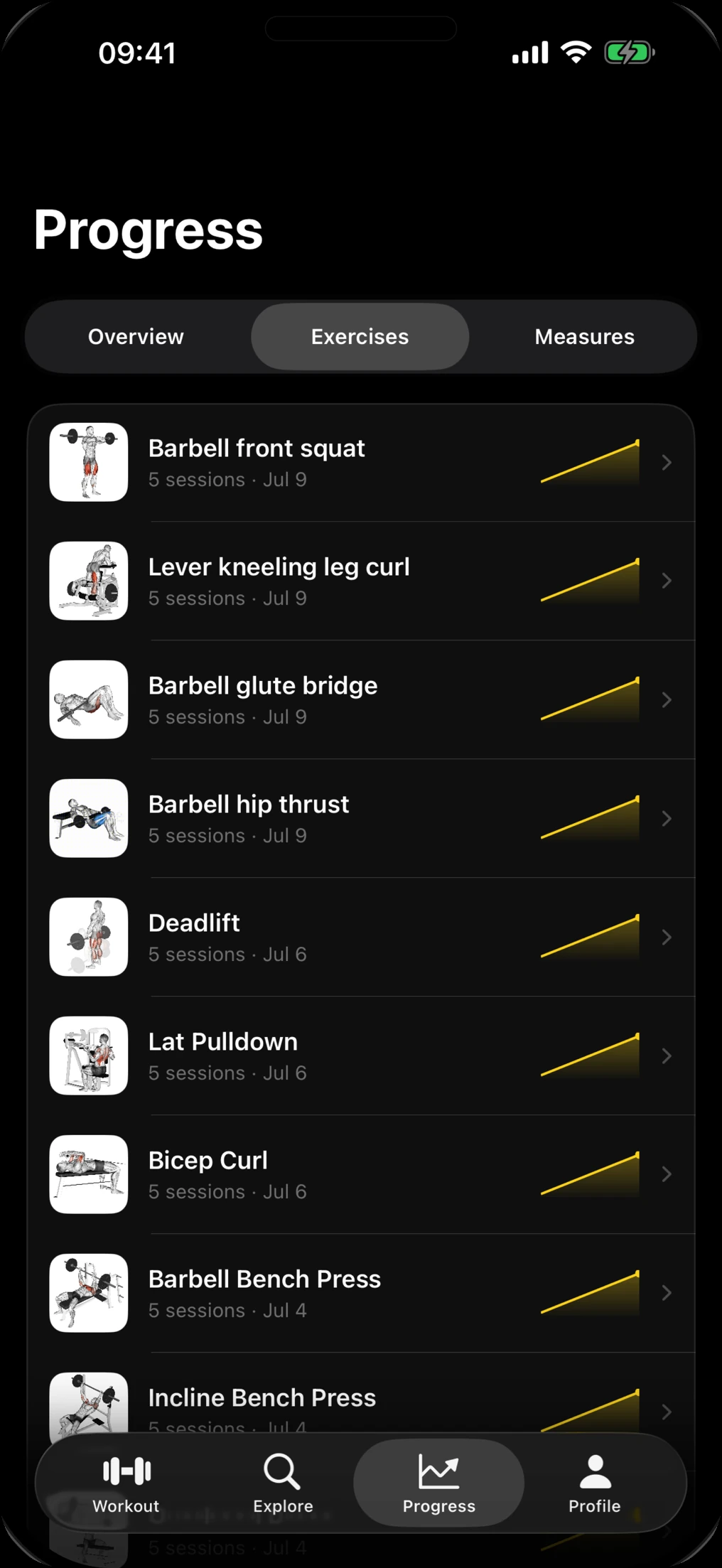
Lift logs every set and charts the max weight you lift on each exercise, with your personal bests one tap away.